Showing posts with label neoliberalism. Show all posts

Friday, 23 October 2020

Transhumanism

Transhumanism: What Is It?

"A philosophical movement that advocates for the transformation of the human condition by developing and making widely available sophisticated technologies to greatly enhance human intellect and physiology."

Those of us who are paying attention cannot fail to be horrified by some prominent people excited by the possibility of transhumanism, those thinking that they are shortly to become a superrace (with prior testing of methodology on lesser mortals), positioned above the people who have remained simply human. 

There is prima facie a lot inherently wrong with the idea of transhumanism. It is likely to make those tampering with their genes and body cells very ill. It is likely to be irreversible and have huge repercussions on other life on our planet. It is likely to affect future generations, whether by limiting fertility or by passing on disastrously faulty genes - both are possible. The RNA-DNA-altering Covid-19 vaccine on the horizon has necessitated a terrifying plandemic in order for enough people to consider the future DNA-altering vaccine a viable measure. Even so, and despite the fact that most people do believe that CV-19 is extremely dangerous for everyone, approximately a third of people surveyed said they would not initially accept the vaccine. Vaccination is at the best of times the injecting of animal cells, mercury, aluminium and other horrible components into humans, including small babies. There are worries that decades of vaccination and bottle-feeding with cows' milk mixed with microplastics has already changed the composition of what it is to be human.

Those we see on video who are fired up by the possibility of becoming transhuman are - only generalising slightly - unempathetic, physically unattractive, nerdy men (mostly) of little moral vision, who in other times would have lived out their small lives without having access to the money and power that our current economic system gives to the least ideal members of our society. They bring to mind the creators of all the great superheroes following WWII, the talented Jewish men who, following the Holocaust, channeled their trauma into stories of unassuming, mistreated men who could suddenly assume supernatural powers and literally right the world's wrongs. But this vision brought in its own new paranoia: the nemesis, the unstoppable villain. 

The added problem is that huge money brings great power over others, especially political power, and power exacerbates sociopathic tendencies. It is hard to look at Bill Gates, Peter Thiel, Elon Musk, for example, and see them as the sort of people you would want in your life. And no amount of money can stop Melinda Gates looking like a reject from The Stepford Wives set.

Binary

But there is another angle on all this. A culture of computer and other devices use has left us very influenced by how algorithms work. Computers are, of course, binary; and randomness is in fact impossible to exactly replicate in a computer, which is why the IT term is 'pseudo-random'. Any programmer knows that you have to think like a machine to programme effectively. The rest of people, the users of the machines, their reactions to content on the screen, whether it be social media, information (or disinformation) sites, etc, is to either click or not click. This is in fact a very masculine way of seeing the world: window open or closed, feeling fine or not feeling fine, take the dog out (for hours) or not take the dog out...

Most will agree that our societies have become polarised and that, worse still, there is a horrible simplicity to everything. You are either with us or against us. If you were against the Iraq War you were for Saddam Hussein. If you thought the Twin Towers was a set-up, you were for Osama bin Laden. You either love everything about Trump or you hate it all. If you do not like Trump, you must like Biden. You either believe in climate breakdown or you do not. And if you do believe it is happening, then you must agree with everything Extinction Rebellion says. If you do not want to be locked-down and do not think it is necessary, then you must be a Trump supporter. If you say that Obama laid the foundations for someone like Trump (while dancing and singing beautifully), you are a Trump-loving racist and misogynist. If you are worried about where neoliberalism is taking us, you must be a raving communist.

Schools constantly test their pupils with on-line yes-or-no quizzes. You either repeat everything you have been told, or you fail. On-line learning is inherently one-directional, allowing for very little debate or behind-the-scenes critiquing of the class content by the pupils.

The tendency is that there are always only two ways of looking at everything.

There is no nuance, no analysis, no holistic understanding about how the planetary ecosystem works; or indeed how politics and the economic system really works, how the financial and electoral political bases, which are very often incompatible, determine what will actually be done and why it will be at such variance with the rhetoric. There is no time nor interest to study information on paper and take detailed notes. The flickering screen beckons with other content notifications and its likes and dislikes. 

The badly-named Right Wing of the political spectrum (those who gain by rampant capitalism) are currently using the Shock Doctrine to ramp up the confusion and lies, making sure that there is literally no time nor inclination to check on facts, so that 'facts' have become a type of triggered opinion. The Left Wing can counter with facts or outrage, but this is not how the game is currently being played; and taking time to take apart one huge lie is useless if the adversary is now onto the next one. In times of aggression, fear and fury, nuanced argument about how capitalism cannot end well, how this is a logical impossibility. finds no receptive audience among those who specifically need a bit of theory in order to understand the world.

We have already become machine-like and, worse still, others are doing the programming.

Wednesday, 29 July 2020

Are We In A World War?

Is it possible that we are in a modern-style World War without realising it?


Prior to WW1


Pre-WWI there were new technologies, globalising, free-trade, a rules-based world economic system underpinned by the leading power of the day (and to its advantage), and a period of general peace among major countries. And the rise of a financial class, with great wealth and power. And huge inequality.

J D Rockefeller is a good example of how extremely wealthy individuals use that wealth to protect their income and power. Rockefeller's wealth soared as kerosene and gasoline grew in importance. 


Amazingly the electric carriage was invented in 1828. In 1888 the first real electric car was invented.  Electric battery-powered taxis became available at the end of the 19th century. Electric vehicles had a number of advantages over their early-1900s competitors. They did not have the vibration, smell, and noise associated with gasoline cars. They also did not require gear changes. The cars were also preferred because they did not require a manual effort to start; no need for a hand crank to start the engine. By the early 20th century electric cars had a potential range of some 100 km and were especially popular among well-heeled customers who used them as city cars, where their limited range proved to be even less of a disadvantage. Electric cars were often marketed as suitable vehicles for women drivers due to their ease of operation. 

So what happened? How is it that they are only now becoming a thing again?

In 1900 in the United States, 40 percent of automobiles were powered by steam, 38 percent by electricity (helped by homes having electricity), and 22 percent by gasoline, but the electric car soon went into decline, due mainly to relentless promotion of the gasoline car, where the real money was to be made, from powerful people like Rockefeller. 

Rockefeller was the richest person in the US, controlling 90% of all oil in the United States at his peak. Furthermore, Rockefeller gained enormous influence over the railroad industry which transported his oil around the country. Standard Oil was the first great business trust in the United States. 

The Supreme Court ruled in 1911 that Standard Oil must be dismantled for violation of federal antitrust laws. It was broken up into 34 separate entities, which included companies that became ExxonMobil, Chevron Corporation, and others—some of which still have the highest level of revenue in the world. Individual pieces of the company were worth more than the whole, as shares of these doubled and tripled in value in their early years; consequently, Rockefeller became the country's first billionaire, with a fortune worth nearly 2% of the national economy. Rockefeller was also the founder of the University of Chicago, whose 'Chicago boys' later on brought us neoliberalism.

Rockefeller spent much of the last 40 years of his life in retirement, defining the structure of modern philanthropy. His fortune was mainly used to create the modern systematic approach of targeted philanthropy through the creation of foundations that had a major effect on medicine, education, and scientific research. Like our modern-day Bill Gates, philanthropy fed back into Rockefeller's personal fortune, supporting business and medical philosophies that increased inequalities and his own personal power. And like Bill Gates (or at least his father) Rockefeller was an avid supporter of eugenics, the set of beliefs and practices that aim to improve the genetic quality of a human population, historically by excluding or eliminating people and groups judged to be inferior and promoting those judged to be superior. The WHO, whose largest donor is now set to be the Bill & Melinda Gates Foundation, was found to have used the tetanus vaccine in Kenya to impose population growth control.

In WW1, the total number of military and civilian casualties in World War I, was around 40 million.
There were 20 million deaths and 21 million wounded. The total number of deaths includes
9.7 million military personnel and about 10 million civilians. Spanish flu in 1918 killed around 50 million. H1N1 (Spanish flu) was a coronavirus that had jumped from chickens to people, as is very often the case with coronaviruses. US military personnel were widely vaccinated (against typhus, smallpox and against a range of other ailments) and the vaccines contained chicken egg cells, and almost certainly chicken viruses. Spanish flu's first documented case was at a US military base in Kansas.

In fact influenza and pneumonia killed more American soldiers and sailors during the war than did enemy weapons, sickening at least 26% of the army, probably more like 40%. The war fostered disease by creating conditions in the trenches of France that enabled the influenza virus to evolve into a killer of global proportions, and soldiers moving around created new foci of contagion among a wider population that was at the time physically deteriorated. Chickens were also kept in horrible industrial-type conditions in order to feed the soldiers, a second relevant point given that coronaviruses typically come from other species, and as a result our immune system is not prepared for them. There was also an inability to separately identify the viral flu sufferers from bacterial pneumonia.

And now?

Modern globalisation has been spurred by some of the same forces that powered the pre-WWI epoch: new technologies, an open, free-trade, rules-based world economic system underpinned by the leading power of the day (with rules to its own advantage), and a period of general peace among major countries. And the rise of a financial class, with great wealth and power. And huge inequality which has returned to pre-World War I levels.

As before World War I, the great wave of globalisation has led to a surge in immigration, both as poor people flee their trashed countries and as large corporations actively encourage the influx of illegal immigrants, at the same time as they warn against it in the media. Large corporations love illegal immigrants, who are cheap and compliant workers, and simultaneously need to stigmatise the immigrant in order to keep them illegal and cheap, while making sure that the general population sees the immigrant as the source of their own personal stagnation or downright poverty and deprivation, rather than the economic order.

In addition to globalisation, technology, social changes and government policies have all been instrumental in determining who benefits and who loses out from global economic integration in past decades.

But globalisation has also hurt some less-skilled workers by exposing them to competition from places with lower wages and taxes, and less meaningful health, safety and environmental laws. In addition, globalisation allows for an easier political scapegoat: it’s easier for politicians to blame foreign countries or individuals for their troubles than technology or their own policies. Technology tends to make even previously skilled workers non-skilled, as witnessed by artificial intelligence, which is at this very moment making a large portion of the things we do susceptible to automation, and to hierarchical control from above, from a very few, extremely powerful number of individuals.

Prior to WW2

Everyone has heard of the 1929 Crash that brought in the Great Depression. Most people think that the hyper-inflation of the Wiemar Republic caused the resentment that in turn caused the rise of the Nazi Party and, ultimately, the Second World War. In fact it was the terms of the Versailles Treaty that imposed firstly a huge debt on Germany and then austerity towards the end of the 1930s in order for the 'creditors' to be paid that caused the German people to turn towards the populist message of Hitler. Which scapegoated immigrants, Jews, gypsies... the other.

85 million people died in the war, excluding those that died afterwards from related illnesses, homelessness, poverty...

And right now?

The CV-19 pandemic (or plandemic - as you wish) has left millions unemployed adding to those jobless or under-employed after the 2008 crash. The horrible Recession of 2008 and onwards, the one we were told we'd recovered from, although our jobs - if we had one - were precarious and depressing, never really went away and was showing signs of resurgence before the CV-19 crisis. 

During these strange and humiliating times full of rules on where you can go, whom you can see, face and hands coverings, biocidal unguents you must slather yourself with, strangers pointing infrared devices at you or sticking contaminated swabs deep into you, biocide drenched mats to walk over, ozone-poisoned offices and shared spaces, biometric tattoos and passports, digital money, isolation, queuing or walking where the arrows dictate, unrequested CV-19 messages on our phones/social networks/computers/TVs... we have belatedly seen that our governments have really huge power over everything we do and that the obscenely rich have great power over them

Many of those who are not happy about all of this are cannon fodder for new populist, unpleasant strongmen, who keep the shocks coming fast and furious, who turn our susceptible gaze towards the immigrants, again fleeing from the extreme poverty or war that our economic system imposes on their countries. Meanwhile our leaders elect are quickly looting the bank vault before they too, like their predecessor, have to skulk off in ignominy, unable or unwilling to deal with their hidden paymasters.

CV-19 (the pandemic or the response to an imagined pandemic - as you wish) has caused a wartime mentality, the "we're-all-in-it-together" feeling, the violent and illogical response of a significant portion of the public to those who are not wearing masks or not walking in the direction the arrows dictate. The same people who in other times would have willingly turned in all the Jews they could to the Gestapo. Along with the immigrant we have this even deadlier enemy, one that is invisible, has no measurable effect on you, that you don't know is inside you, and which makes you and everyone else a deadly threat to everyone else, without you knowing it.

664,000 have died from it, possibly at least, as it seems that less people are dying from other causes, suggesting that CV-19 is being used to group deaths from other causes. In any case, a number similar to a bad flu season (250,000-600,000, WHO). Many will die from having their elective surgery or other medical treatments postponed during these months. Some will do better, having not seen the doctor. Small children whose vaccination has been postponed will probably do much better. But depression caused by the lockdown and other measures will cause a significant reduction in life expectancy for many, with potentially soaring suicides and drug-related deaths, especially when the dire job situation becomes apparent. 

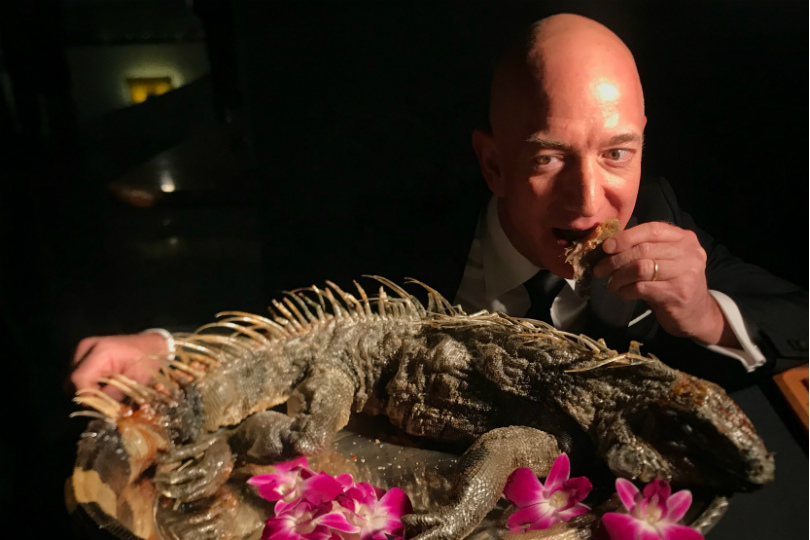
During all this the obscenely rich have become much, much richer. Jeff Bezos broke all records when he increased his fortune by $13 billion in one day. If that isn't the rentier economy that Adam Smith warned us against, I don't know what is! Bezos, like the old aristocracy that used to dine on peacocks' tongues, lives a life far distanced from normal mortals and will eat just about anything so long as its disgusting enough.


In any case, if this is a covert war it is working well as concerns making the rich richer, keeping us all looking the other way, and restructuring the world. But what about population reduction?

Whatever you think about CV-19 itself, you have to admit that no one is really dying from it at the moment. If you believe the official figures, which seem to include an awful lot of people who die having had a positive test result in the past at some point but not necessarily from CV-19, 4,000 people a day in a world of nearly 8 billion is not very many. As a practical consideration, were we all to live to a hundred, around 0.0027% of us would die every day. Currently 0.00007% are officially dying from coronavirus, so approximately 2% of deaths are due to this coronavirus, the rest are coronary artery disease, stroke, lower respiratory infections, chronic obstructive pulmonary disease (emphysema, bronchitis), lung disease and cancer, diabetes, Alzheimer's and dementia, diarrhoea, TB, road injury (in order)... In fact even this is not true: ALL the CV deaths had another underlying cause.

Note that road injury - a most preventable cause - kills twice as many per year as CV-19 has ever and, yet, no one is fretting about that. We stopped our economies for CV but never contemplated such a thing for road injury, which in 6 months kills as many as CV ever has.

Forget the asymptomatic CV-carriers. If they are carrying an illness which they can transmit and which is still not going to kill others, are they at all relevant? At its most virulent, CV has killed as many people as are murdered in a year in the world. Do we wish to lock up everyone because they may be a homicidal maniac?

You have to have a really blind faith in our deep state not to smell a rat of some sort, either grave conspiracy or plain old incompetence. Quickly forgotten are all the solemn speeches about China's lack of personal freedoms and democracy, as it becomes our model for how people should be ordered about.

China for 35 years, till 2015, had a 'one-child policy'. Those that were powerful or had money to bribe officials had more children, but those that depended on the state for welfare (as the unemployed, underemployed, furloughed, underpaid are) abandoned baby girls in huge numbers and bred pampered, lonely male children. Even in 2007 36% of the population was subjected to the policy, the rest having a series of exemptions. China now faces a serious demographic problems with the excess of lonely males who cannot marry, and old people facing a lonely old age.

It does seem that we are very shortly to be given the choice of never being able to go out, let alone travel, or accepting a vaccine that is largely untested, potentially lethal, probably useless against coronaviruses and unnecessary, as CV-19 is of late a non-story. Our collective immune system ALWAYS adapts to new viruses in time. 

Is the vaccine, as many suspect, a Trojan horse to further reduce our fertility? Our elites almost certainly do not vaccinate themselves or their children: witness Tony Blair's refusal to answer this question in parliament, Bill Gates' doctor's comments, Zuckerberg's rather too public filming of his children at the clinic, Australia's NSW premier pretending to be vaccinated while the cap was on the syringe - there are too many instances to enumerate. 

Hysteria was ramped up at the beginning with photos of coffins and the like. We never saw them in our own streets, although we did get to see nurses just about everywhere going through dance routines. Hysteria is now kept going - despite the dearth of even potential death suspects - with the contradictory narratives of asymptomatic illness (think about it); and - if you prefer - so few cases as to confer no herd immunity at the same time as hundreds of thousands of positive test results.

Will the new, largely untested vaccine get the second result of a WW done: population control? Vaccine trials are already being pushed in parts of Africa and Indian slums, although we are told that people there are NOT ill. After all, as The Guardian's headline shouts, "over half the people living in the slums of Mumbai have had the coronavirus", but way down we hear that "the survey results suggested asymptomatic infections were “likely to be a high proportion of all infections” and also indicated the virus death rate was likely to be “very low”."  (One also wonders why The Guardian puts "very low" in inverted commas.) Will the vaccine sterilise us, as previous others have provably done? Will it make us weaker and iller, when this coronavirus - and no doubt future ones - weeds out the old and infirm?

Is this our new war, one we're sleepwalking into again? Are millions about to be willingly culled or sterilised, and will these same millions oblige the rest to be unwillingly culled or sterilised? Is the world order being intentionally reconfigured so that a handful of billionaires can get still richer while the obsolete masses are quarantined or exterminated?


Saturday, 9 May 2020

Why Private Healthcare Makes Public Healthcare Worse

Like so much that goes on today, there's an idea that private healthcare does not impact public healthcare and can even lessen the burden on the public system. Years of neoliberal simplification of everything into pounds and pence, always understood as today's pecuniary cost, often an imaginary spin on the real cost, without taking into account other repercussions or future impacts, have meant that, even though we can see that every year is a little worse than the previous one, we cannot see why that is. We continue to be told that, if we just apply the selfish, everyone-in-it-for-themselves, I'm-all right-Jack doctrine, suddenly, magically, everything will come out fine.

It was a historic triumph in almost all modern countries - excluding the USA - to achieve a National Health Service, a stunning symbol of solidarity in the community. 

As Aneurin Bevan, the creator of the NHS in England and Wales in 1948, said, “Illness is neither an indulgence for which people have to pay, nor an offence for which they should be penalised, but a misfortune, the cost of which should be shared by the community.” We apply the same principle of solidarity to state education or welfare payments and the arguments for a national health service are more or less the same as for other forms of solidarity within a community.

Margaret Thatcher famously said that there is no society, only individuals. Were this true, it would be a sad and depressing reflection on humankind. But it is not true: we are social animals and become dysfunctional the more isolated we are.

Most people in favour of private health care pay at least lip service to the notion that the national health service should be maintained.


But...

The very existence of private health care undermine the principle of solidarity, one of the most precious foundations of our coexistence with other beings. Do we really want to return to having to avoid others in the street for fear of their carrying dangerous diseases that they cannot afford to have cured?

Bill Gates used to have a huge public image problem, arising from his unattractive personality, his criminal undermining of all competition to Windows (and its awful browser), his sullen and shifty performance in the the US anti-trust court case against him, and his ubiquitous and horrible OS and browser. That was until he took advantage of the neoliberal creed that the wealthy managed to foist on us of hardly taxing the very rich. His soaring wealth allowed him to reinvent himself as a health expert and philanthropist. Luckily for him, all that giving was mostly to his own organisations or those he controlled, and it always worked towards his own interests (of gaining power over 99% of the world) so that, although Microsoft is only 20% of his portfolio, his wealth has doubled during these years of "giving", from $50 billion to $100 billion over the last decade.

Amancio Ortega, Zara's immensely rich owner, chooses to produce its garments using cheap labour abroad where the minimum wage is truly minimum and where health and safety measures are in short supply. Zara pays taxes in Holland, Ireland and Switzerland, not Spain, saving itself at least 585 million euros from 2011 to 2014.

There are Irish companies belonging to Inditex that report millions of euros in turnover, but do not have a single employee on the payroll and paid no corporate tax at all.

Ortega is worth more than 62 billion euros, and his yearly dividend is around 270 million euros per year or, if you like 739,726€ per day. Just 514€ per minute, every minute of every day of the year! He  donates from time to time to the health service in specific machines - mostly inappropriate for the public health service and requiring expensive maintenance - or surgical masks, gaining huge popularity. His donation, made possible by starving the Spanish state of the taxes it should receive and by ensuring that Spain's unemployment rate is never mitigated by his company, is always specific, never in cash, and never democratically accountable. It gives him an incalculable value in cheap publicity at an insignificant cost. 

Worse still, as these donations reduce his tax bill, a substantial sum of money comes out of the public purse to pay for these generally useless so-called gifts, should they be accepted. As they say - and, pertinently, was first documented as being put into common parlance in the 1930s during the Great Depression -, there's no such thing as a free lunch (TNSTAAFL).

Philanthropy does not, and cannot, substitute for a proper, solidaristic State. State institutions, when they work, when they have not been undermined and infiltrated by rich, vested interests, protect against the venal interests of particular individuals. Both Gates and Ortega have no medical nor medical research training, yet are able to use their tremendous wealth in order to pressure governments into buying into their agenda. Neither support, either ideologically or economically, the national health service. Gates has received huge pledges of money from most western governments in order to fund the vaccine he intends to use on the entire world population against Covid-19 (excluding his own family, I have no doubt). They will start with Africa, I suspect, although Africa really does not have a problem with the coronavirus. Yet.

As we have just seen, the private health services do NOT generally cover serious new infectious diseases, be they Covid-19, Sars, Mers, Ebola, HIV, tuberculosis..., nor do they cover pre-existing illnesses. New minor ailments are covered but the yearly premium quickly becomes prohibitive once they become serious or chronic. Private health services scrimp on personnel costs, often employing trainees and insufficient qualified staff. When things go wrong, as they often do, patients are frequently transferred to the public hospital, at public cost, never the other way round, and the public sector ends up with patients who may need very expensive life-long treatment, often as a result of mala praxis or incompetence while in private care.

For years, governments have been stealthily selling off the NHS, sending patients for minor treatments to private clinics and paying these clinics for the service. The private clinics make a profit (that is what they are there for), money that should have been saved or invested into the public sector. The public sector increasingly ends up with a disproportionate number of poor, very ill, or chronic patients, making its cost per patient far higher than the private sector's. This leads it to be criticised by unscrupulous people who can then justify further privatisation.

The Centre for Health and the Public Interest claims that post-operative care is generally carried out by a junior doctor, one who is working up to 168 hours a week without supervision.

The criminal surgeon Ian Paterson, who treated more than a thousand patients fraudulently at private hospitals under Spire Healthcare and carried out useless, life-changing operations where many of his patients died and hundreds were mutilated, cost the NHS more than £17m in compensation to victims. Patients were referred to him due to the NHS's long waiting lists, following decades of intentional mismanagement of the NHS, despite Ian Paterson having a dubious background and previous suspension. He was ultimately sentenced to 20 years' prison, and his motive is assumed to have been simply to earn more money.

Such is the incentive to make a profit and line some specific pockets that in Madrid during the Covid scare the authorities dolled out free masks, overalls, gels and the like to the private care homes, valued at 3.2 million euros; and sent many patients to these private centres although there was room in the public ones, costing another million euros. At the same time the overwhelming proportion of deaths was in the private care homes, where many patients were isolated, abandoned, and purposefully not given treatment for illness, nor water, nor food. These deaths tended to be of old people over 70 years of age, in private macro-'care' homes, while the small public sector homes had much better outcomes. Private 'care' and hospitals cost up to six times more than public sector ones.

As Noam Chomsky famously said, "That’s the standard technique of privatization: defund, make sure things don’t work, people get angry, you hand it over to private capital."

Other surgeons, like Dr Arackal Manu Nair who carried out unnecessary prostate operations at Spire Parkway private hospital in Solihull, have also been suspended after years of abusing patients, years too late for their victims, due to lack of oversight and the way that doctors are outsourced and allowed to have private practices elsewhere.

In small, fragmented clinics, consultants, who carry out the surgery, do not hang around to look after their patients afterwards but disappear home. Private clinics often do not have intensive care facilities and, if they do, they may well not have sufficient qualified staff permanently on hand. The transfer to a public hospital also transfers a large cost to the public sector and, at the same time, further endangers the patient's life by the transit.

In 2018, a report by the CQC into the independent sector was scathing. It found two in five private hospitals were failing to meet safety standards. In particular it raised a major concern into the lack of effective oversight of consultants "working" for the hospital but not formally employed by them. It also said there was not enough reporting of serious incidents or transparency when something went wrong.

Mr Patterson worked independently, the private hospital he worked at did not employ him (clinicians are effectively freelance) and he had his own insurance.

So, when something went wrong, as it so cruelly did, the hospital was able to claim it was not liable (though Spire healthcare has paid out some damages to some patients as has Mr Paterson’s insurance company, but the victims had to fight tooth and nail to get it).

The public health system often seems expensive not only because it treats the most expensive patients (and continues to do so even when extensive private healthcare is available), but also because it incorporates safety and quality procedures and maintains permanent in-house staff. The private sector charges far more in fact but will always end up cutting corners, because it exists in order to make a profit, the larger the better. The US has a highly privatised healthcare system that per capita is the most expensive in the world, yet the US is ranked number 38 in life expectancy.

But far more insidious is the fact that private healthcare starves the public sector of its resources. Imagine if $9,892 per person were used for a public sector healthcare budget in the US. Instead, the biggest cause of personal bankruptcy in the US is medical treatment, despite the country's huge healthcare cost. And yet, over 6 decades, surveys have repeatedly shown that the US population is overwhelmingly in favour of a public, single-payer healthcare system; yet, the private industry's lobbyists ensure that this never happens.

A near-universal single-payer public service can negotiate cheap medicines and supplies, due to the fact that its very size makes it a match for negotiating with any laboratory. Witness the cost of medicines in the US compared to Canada: an Epipen (for serious allergic reactions) typically costs $100 in Canada and $300 in the US. In the UK you will be charged £8.80 ($11). However, the NHS buys them for around £45 ($58).

The last reason why a private system will never coexist in harmony with a public system is that the current system is now out of date. Covid-19 and other recent pandemics shows that infectious diseases, which have been long on the back foot, are perhaps coming back, for whatever reason. Possibly the reliance on vaccines for decades has allowed viruses to mutate and, together with increasing poverty and precarious health for a significant part of the population, allowed them to get a new hold on us.

These infectious diseases must be kept separate from chronic diseases and, indeed, Covid-19 has been shown to be on a practical level dangerous only for those who are chronically ill, who should have been kept away from the Covid-19 patients, but were not or - equally worryingly - have not been able to receive their customary treatment due to hospital saturation with Covid-19 patients.

For any area with sufficient population to warrant a hospital, at the moment the paucity of the public sector ensures that, although there will also be various private clinics, there will not be sufficient resources for there to be a second public hospital, to treat the infectious patients in a different facility to the chronically ill.

We should realise that health is a communal issue and that other people's health affects ours. For that reason alone we should invest in a first class public health system and ditch the idea that a two tier system can do anything decent for us. 

Sunday, 12 April 2020

Debt and War Metaphors

Before CV-19 struck massive debt had been built up over decades in western nations. Trickle-down theory, much propounded by Margaret Thatcher, was in fact more like Make-the-filthy-rich-even-richer, and everyone else quite a bit poorer.

In the UK, external debt is $127,000 per capita (116,135€), ie for every man, woman and child. I bet you did not know you owed quite so much! In Spain it is $48,700 but Spain is a much poorer country and this figure is equally distressing. Of course, this amount does not include what you owe within your country to banks and other lenders, so your patrimony is probably far lower.

The secret of our capitalist world's functioning is debt, which is just another way of saying that our wealth will have to be paid for by future generations (be it money, depleted resources, dealing with climate breakdown, species extinction, pollution...).

The US debt clock is a scary thing to look at, and more so if you look at the bottom and see that unfunded liabilities, ie those with nothing to back them up, are running at $147,506,000,000,000 ($148 trillion) at the time of writing. By the time you look at the clock, it will be far higher. We have, over decades of neoliberal creed and austerity (what an Orwellian term that is!) built up the sort of debt that in other times would have been the result of war and destruction.


Our economic system is also one that mercilessly pits one person against another, where we see others as competitors for resources (be it money, housing, the latest iPhone...), not as collaborators in a common project and certainly not as allies in order to stand up to the real enemy, the 1%, whose lifestyle is trashing the planet and which purchases power and ensures that our democracies, with their two competing and identical parties, cannot function as such. We live in a permanent state of literal war (all the large Western nations are participating continually in diverse wars in which yesterday's ally is very often today's enemy), and in a metaphorical permanent war as we compete with others and against our very selves, battling against disease or punishing ourselves with arduous workouts on a treadmill.

Our current belligerent vocabulary of fighting the virus, being all in it together (the little people, that is), taking it on the chin, etc provides a fitting metaphor for the huge debt, ie fitting for a war economy. The debt itself in turn requires a continual state of austerity for the 99%, itself a state of war against the poor and the very vulnerable. As your birth will largely determine your level of wealth, or in other words as meritocracy is a lie, the idea that the poor should shoulder almost all austerity is truly gross.

When I was a child I had a funny graphic-novel T-shirt that had an ill-looking man and his girlfriend asking him, "Is it angst, Jim, or too much beer?" Now, we are indeed most of us almost clinically alcoholic, like the inhabitants of the USSR at the moment of its decline, enjoying nothing - literally nothing - as much as sinking wearily onto the sofa with a glass, or bottle, of wine. But angst? - there is no room in our world for artistic or alternative visions. Those who cannot man up and march off to work (no CV-19 problem there) and then hurry home, never interacting with others, whether because of street crime or CV-19, to drink a bottle of wine, those people are today termed mentally ill. They will be ruthlessly medicated with antipsychotic drugs that will make them depressed, mad and bad; or thrown out into the street - either way the contribution they could have made to our overly predatorial and funcional society will have been neutralised.

Today's belligerent words, whether it be "war on terror", "battling cancer" or the "war against the coronavirus", these are all empty concepts, but full of emotion nonetheless. Edward Bernays built on Freud's insights, and created the propaganda industry, what we like to call advertising. We are animals manipulated by our emotions and fear overrides everything. We now, in our CV-19 panic, have a war on death!

The physical War on Terror was called, rather aptly "Shock and Awe", synonyms of what we were supposed to be fighting against, although we were in fact inflicting great harm (and shock and awe) on the planet's poorest people. Those who have cancer and die just haven't "fought" enough, although the problem is their own body, parts of which are removed and taken away in a futile show of making them whole again. And governments fighting against a virus - what does that even mean?

Almost the only ones who are dying in this war are old, infirm people, dying alone, scared witless by the incessant propaganda on TV and by the Star Wars-clad medical personnel around them, intubated, inarticulate and in horrendous loneliness, without so much as a cup of tea and chocolate biscuit to ease their passing. This is what our decadent civilisation has to offer as quality of life: useless, repetitive studies, followed by unmeaningful, precarious, stressful work, followed by illness, followed by painful and terrifying death.

Did the 3,000 years following the Ancient Greeks' ideal of a "good life" lead us to this?

Friday, 20 March 2020

The Generational Divide

There has been a lot of intentional confusion about the Baby Boomer generation so I am going to start with a bit of history and a few definitions taken from Wikipedia.

First of all, the Baby Boom Generation is the demographic cohort following the Silent Generation and preceding Generation X. The generation is most often defined as individuals born between 1946 and 1964, during the post–World War II baby boom.

The preceding generation, the Silent Generation is defined as individuals born between 1928 and 1945. This generation was comparatively small because the financial insecurity of the 1930s and the war in the early 1940s caused people to have fewer children.

The modern welfare state was initiated in the United Kingdom with the National Insurance Act in 1945, creating compulsory contributions from employees and relief for unemployment, death, sickness, and retirement, followed by laws shortly afterwards to provide cover from the "cradle to the grave". All this was initiated while Britain was burdened with a 400% debt to GDP, due to the Second World War, a huge amount, and it was achieved through political will and immensely talented politicians, almost entirely from the Labour Party, and the foresight of a generation that understood the value of solidarity in any human endeavour.

(That said, the Spanish Second Republic long before, in 1931, brought in popular sovereignty and universal suffrage, freedom of meeting, association, and expression, divorce, co-education of
boys and girls and the end of religion as a mandatory subject taught in schools, among other things.)

In the USA the beginnings of a true welfare state, brought in by the F D Roosevelt government (1933-1945) were well initiated but effectively pushed back later on by the far Right.

The Silent Generation was a small, motivated and solidarious generation that won the rights that we most value now. It was an altruistic generation that had gone through a terrible war, with the spirit of them being all in it together.

They were followed by the Baby Boomers in two large demographic waves: the first cohort from 1946 to 1955 was far larger than the second from 1956-1964. Both have proved to be staggeringly selfish and lacking in empathy (especially the first cohort), short-sighted (both) and intellectually inept (especially the second). The successful 1987 film Wall Street emblemized the Baby Boomer creed with Gordon Gekko saying, "Greed is good", and telling us that it was all a game. Trickle Down Theory could never have worked but it sounded good to greedy people, that all would benefit from each of us grabbing as much as we could. Many of the most influential of them avidly gobbled up turgid prose and half-baked ideas from Ayn Rand that gave credence to their inner desires, that selfishness and lack of consideration were good things in the greater scheme of things.

During their lives the Baby Boomers, especially the first cohort, have ruled the roost every time they've voted, whether they voted for Ronald Reagan (President of the USA in 1981) or Margaret Thatcher (Prime Minister of the UK in 1979), and when they later voted for Bill Clinton in the US or Tony Blair in the UK.

Reagan and Thatcher brought in the entirely common-sense idea that a government should balance its books. It sounded good, although it is in fact grossly unfair. The same large generation that had cost a previous generation so much to nurture and educate, when it came to their productive years, the years they would pay taxes, voted to reduce those taxes and "balance the books". Not a word about balancing the books when they have retired, and they are once again a massive drain to the state (pensions are 13% of GDP in the EU, not taking into account healthcare, free public transport or other costs). During decades, states were hollowed out, ensuring that politicians in the main represent the Corporate Party and that welfare and decent jobs are now absent for large parts of the population.

The second cohort has been passive to an extreme, generally being led by the first on all matters of opinion. Generations that have followed have been small enough to ensure that their political opinions are irrelevant, leading all but the old to be entirely passive as concerns voting and politics. At this stage, many of the second cohort have not yet reached retirement age and some may have potentially little pension to look forward to nor substantial savings, unlike those of the first cohort.

These years have been of neoliberalism, of sociopathic leaders supporting imperial and corporate interests, and have been years of shocking corruption and decadence. It is a well-known fact that left-wingers and young people do not vote in the main, in many cases because they are the same people and time has shown them that nothing will ever change whether they vote or not. The official left-wing opposition is left-wing in name only, it talks the talk but does not walk the walk. There is so much money from vested interests mixed up in politics and the mainstream media that it would be difficult to imagine any politician who won power being in a condition to change things anyway.

The result of all this greed, competitiveness and self-preening has been the trashing of the lives of those that are weak, be it other people or those unfortunate animals that come into our cross-hairs. A generation has trashed the environment, ditched hard-won human rights, waged constant war, voted for unbelievable corruption, denied later generations a decent education beyond regurgitating useless data, and by its sheer force of numbers made sure that nothing ever changes, at least until it is no longer around to face the music.

And now we have the mother-of-all economic crises upon us, brought about by the mother-of-all pandemic propagandas (and I wonder if that itself was caused by the underlying mother-of-all climate crises). We are happily ditching the economic future of the young and those of working age in order to supposedly safeguard the health of the very old and infirm, locked up and terrified as they are, watching scary TV on their own, hour after hour. The rest of us, those who still had a future a couple of weeks ago, are being thrown into the trash can, and for nothing. Because once again, the Baby Boomers have got it all wrong and they are being taken for a ride.

They are at it again!

Monday, 24 February 2020

Absurdities of our time

Following several storms in the UK, and some really awful images of water pouring through a house in Wales, I see in The Guardian that "more than 11,000 homes in England to be built on land at high risk of flooding." If there's a buck to be made, short-term, that is, there the UK government is to be found. We desperately need some long-term planning, and some strict rules to make sure that government employees cannot earn money elsewhere and have to declare their wealth before and after office, and justify the difference between them. We need big inheritance and wealth taxes to redistribute wealth and stop the obscene plunder that accompanies all these horrible decisions.

The previous Prime Minister, Theresa May, took the UK to war with Syria. As a national policy decision it was immoral and futile. However, her husband, Philip, essentially acted as the unofficial advisor to the Prime Minister while being a Senior Executive at a £1.4Tn investment firm.

The fact that Philip May is both a Senior Executive of a hugely powerful investment firm, and was privy to reams of insider information from the Prime Minister – knowledge which, when it becomes public, hugely affects the share prices of the companies his firm invests in – made Mr May’s official employment a staggering conflict of interest for the husband of a sitting Prime Minister.

Philip May is a Senior Executive of Capital Group, an Investment Firm which buys shares in all sorts of companies across the globe – including thousands of shares in the world’s biggest Defence Firm, Lockheed Martin. Philip May’s Capital Group owned more than 7% of Lockheed Martin in March 2018 – a stake said to be worth more than £7Bn at this time. His Capital Group is the largest Shareholder in BAE. Shares soared with the Syrian airstrikes, following the so-called chemical attack on the city of Douma, now shown to be false and reported at the time as in all probability false by Robert Fisk of The Independent. Those airstrikes saw the debut of a new type of Cruise Missile, the JASSM (each cost more than $1 million), produced exclusively by the Lockheed Martin Corporation. US President Donald Trump  tweeted that the weapons being fired on Syria would be “nice and new and 'smart'!”

The share price of Lockheed Martin soared and Philip May's firm made a fortune.

Thursday, 20 February 2020

The Neo-liberalism Myth

Margaret Thatcher’s neoliberal revolution wasn't just successful because it reorganised the economy – it was successful because it embedded a particular narrative about how wealth is created and distributed in society. This is a world where, so long as there is sufficient competition and free markets, every individual will receive their just rewards in relation to their true contribution to society. Where a rising tide lifts up all the boats. There is, in Milton Friedman’s famous terms, “no such thing as a free lunch”. It’s a world where businesses are the “wealth creators” who create jobs and drive innovation, and business owners are entitled to the financial rewards of success – regardless of how enormous they are. It wasn't like that, of course. Every time that the rich and their companies become insolvent, they are bailed out, from easy bankruptcy for the very rich who are then allowed to refloat themselves with cheap and extravagant loans, through subsidies to large corporations that end up paying no tax, lack of action on fiscal paradises, through to bank bailouts. Socialism for the rich, capitalism for the poor.

Tony Blair and Bill Clinton’s ‘Third Way’ largely accepted this narrative of wealth creation, and until relatively recently nobody in the mainstream of British politics challenged it. It is what is taught in business schools and really nothing alternative is every studied or taught.

The problem, of course, is that it bears little resemblance to how the economy actually works. While it is true that working hard will generally help you earn money, you won't necessarily earn more this way. And the causality doesn’t hold in reverse: not all wealth has been attained through hard work. In practice, the distribution of wealth has little to do with contribution, and everything to do with politics and power. The current campaigns against inheritance and wealth taxes are supported by many people who will not benefit overall from them. The Thatcherite narrative that taxes are bad took hold and the alternative thesis that they are part of a decent, redistributive, collaborative society has been silenced. The narrative that owners are the only important stakeholders is also palpably false, and excludes others affected by economic activity, such as those who live nearby, consumers and workers.

Someone that is born in the UK will earn more than someone born in Sub-Saharan Africa, even if they perform exactly the same labour. Why? Because one was lucky enough to be born in a powerful country with a legacy of imperialism that has rigged the rules of the global economy in its favour. It is the same in London compared to the north of England, say. The economist Branko Milanovic has estimated that 60% of someone’s income is determined by where they were born, and an additional 20% is determined by the income level of their parents. This means that place of birth and parental background accounts for around 80% of someone’s earning power on average.

Within countries, extreme fortunes almost always derive from control over a scare resource – fossil fuels, minerals, land, monopoly networks, money etc. To the early classical economists, this kind of wealth – attained by simply being a gatekeeper to scarce resources – was deemed to be unearned, and they referred to it as ‘economic rent’. But today the Sunday Times Rich List is dominated by rentiers – financiers, real estate tycoons, oil barons, monopolists and aristocrats.

As Grace Blakeley puts it: “You do not become a billionaire through labour. You become a billionaire through inheritance, corruption or economic rents – or, in most cases, some mixture of all three.”

But it’s not just billionaires that accumulate wealth without working. Over a third of all the income in Britain is paid out as capital income (dividends, rents and interest) rather than labour income (wages and salaries). Capital income is inherently passive: it doesn’t correspond to work or skill, but ownership.

Since 1995 three quarters of all wealth accumulated in the UK – totalling £5 trillion – has come from rising house prices. The driving force behind rising house prices has been rising land prices. But land is not a source of wealth but of economic rent. The truth is that most wealth made through the housing market has been gained at the expense of others who are now seeing more of their incomes eaten up by higher rents and larger mortgage payments. The housing boom is not an example of wealth creation, but wealth redistribution on an unprecedented scale.

And then there is inheritance: around £100 billion of wealth is passed on to new owners every year without any corresponding productive activity, much of it escaping any tax.

Overall, the proportion of wealth in western countries that can truly be ascribed to “hard work”, however loosely defined, is infinitesimally small. The idea that Britain is a meritocracy is objectively false.

This means that we should start to recognise that wealth creation is a collective process involving many different interdependent stakeholders – workers, the government, the natural environment, civil society, and, yes, entrepreneurs. It means highlighting how the mechanism linking contribution and reward for each of these stakeholders is fundamentally broken: workers are being paid less than the value they create, owners are appropriating wealth they didn't create, vast profits are being made by destroying our ecosystems, and the role of the state in wealth creation is undervalued. And it means proposing new mechanisms for distributing financial rewards that more accurately reflect the collective nature of wealth creation, and rebalance power between capital and labour.

Crucially, it also means challenging the idea that rising asset prices – Britain’s favourite form of wealth – constitutes wealth creation. As John Stuart Mill wrote back in 1848:

“If some of us grow rich in our sleep, where do we think this wealth is coming from? It doesn’t materialise out of thin air. It doesn’t come without costing someone, another human being. It comes from the fruits of others’ labours, which they don’t receive.”

The extraction of natural resources and the externalisation of costs that are so intrinsic to capitalism are nothing but the transference of wealth from one future generation to the present one. The ownership of land, together with inheritance laws that protect rich families, enables the concentration of wealth in few hands.

Great inequality is incompatible with democracy because money is used to buy power in a corrupted representative system. Learning that there a now more billionaires than ever, individualistic neoliberalism has encouraged the greedy to think that they too might climb up and be the new Jeff Bezos, and to hardly spare a thought for those unfortunates that aren't winners in this winner-takes-all system, accepting the lie that it's mostly their own fault anyway. If they stopped to think about it, there is no millionaire class if everybody's a millionaire. Being rich requires that you can buy the labour and land off those who are poor. As George Carlin said, ‘it's a big club, and you ain’t in it.’

Wednesday, 19 February 2020

Irish Elections 8.2.2020

I can remember when Sinn Féin was banned and when Bobby Sands, a young elected MP, died on hunger strike. Back then it was said that he'd been manipulated by the party, as if the old, white men who always end up ruling us had any ideology that was worth its salt.


But this time round, Sinn Féin has broken the bipartisan consensus, getting 37 seats, only one less than the party who got most seats. And despite being excluded from the debates (so-called) and being constantly erased from MSM as a serious contender. 

And those who have got used to sharing power in Ireland take the threat of democracy actually meaning something very badly. They are echoing the ridiculous smears levelled at Jeremy Corbyn in the UK election just before last Christmas, talking about bombs and terrorism. The fact is that those living on the streets as a result of the daylight robbery that was foisted on us all in the western world, ie austerity, have a current life expectancy of 42 yrs for men, and 37 for women. And more people have killed themselves since 2008 in Ireland, during these years of so-called austerity, than died during the Troubles (between 1969 and 1998). Micheál Martin, who expected to win and had instead an awful result, retorted to Afshin Rattansi, of Going Underground, that the suicide rate was higher in Northern Ireland, which seemed a particularly stupid thing to say, when being asked why voters turned their back on the 2-party system.

That said, the 2016 Spanish General Election put Podemos, from the "15-M Indignados" movement, in third place and polling had suggested they might get to second place, breaking the two-party system. But their early promise seemed to peter out and subsequent elections had worse results for them. They are now in a coalition government and it remains to be seen if the large, centrist (in a right wing spectrum) PSOE will end up declawing Podemos.