Is it possible that we are in a modern-style World War without realising it?
Prior to WW1

Pre-WWI there were new technologies, globalising, free-trade, a rules-based world economic system underpinned by the leading power of the day (and to its advantage), and a period of general peace among major countries. And the rise of a financial class, with great wealth and power. And huge inequality.
J D Rockefeller is a good example of how extremely wealthy individuals use that wealth to protect their income and power. Rockefeller's wealth soared as kerosene and gasoline grew in importance.

Amazingly the electric carriage was invented in 1828. In 1888 the first real electric car was invented. Electric battery-powered taxis became available at the end of the 19th century. Electric vehicles had a number of advantages over their early-1900s competitors. They did not have the vibration, smell, and noise associated with gasoline cars. They also did not require gear changes. The cars were also preferred because they did not require a manual effort to start; no need for a hand crank to start the engine. By the early 20th century electric cars had a potential range of some 100 km and were especially popular among well-heeled customers who used them as city cars, where their limited range proved to be even less of a disadvantage. Electric cars were often marketed as suitable vehicles for women drivers due to their ease of operation.
So what happened? How is it that they are only now becoming a thing again?
In 1900 in the United States, 40 percent of automobiles were powered by steam, 38 percent by electricity (helped by homes having electricity), and 22 percent by gasoline, but the electric car soon went into decline, due mainly to relentless promotion of the gasoline car, where the real money was to be made, from powerful people like Rockefeller.
Rockefeller was the richest person in the US, controlling 90% of all oil in the United States at his peak. Furthermore, Rockefeller gained enormous influence over the railroad industry which transported his oil around the country. Standard Oil was the first great business trust in the United States.
The Supreme Court ruled in 1911 that Standard Oil must be dismantled for violation of federal antitrust laws. It was broken up into 34 separate entities, which included companies that became ExxonMobil, Chevron Corporation, and others—some of which still have the highest level of revenue in the world. Individual pieces of the company were worth more than the whole, as shares of these doubled and tripled in value in their early years; consequently, Rockefeller became the country's first billionaire, with a fortune worth nearly 2% of the national economy. Rockefeller was also the founder of the University of Chicago, whose 'Chicago boys' later on brought us neoliberalism.
Rockefeller spent much of the last 40 years of his life in retirement, defining the structure of modern philanthropy. His fortune was mainly used to create the modern systematic approach of targeted philanthropy through the creation of foundations that had a major effect on medicine, education, and scientific research. Like our modern-day Bill Gates, philanthropy fed back into Rockefeller's personal fortune, supporting business and medical philosophies that increased inequalities and his own personal power. And like Bill Gates (or at least his father) Rockefeller was an avid supporter of eugenics, the set of beliefs and practices that aim to improve the genetic quality of a human population, historically by excluding or eliminating people and groups judged to be inferior and promoting those judged to be superior. The WHO, whose largest donor is now set to be the Bill & Melinda Gates Foundation, was found to have used the tetanus vaccine in Kenya to impose population growth control.
In WW1, the total number of military and civilian casualties in World War I, was around 40 million.
There were 20 million deaths and 21 million wounded. The total number of deaths includes
9.7 million military personnel and about 10 million civilians. Spanish flu in 1918 killed around 50 million. H1N1 (Spanish flu) was a coronavirus that had jumped from chickens to people, as is very often the case with coronaviruses. US military personnel were widely vaccinated (against typhus, smallpox and against a range of other ailments) and the vaccines contained chicken egg cells, and almost certainly chicken viruses. Spanish flu's first documented case was at a US military base in Kansas.
In fact influenza and pneumonia killed more American soldiers and sailors during the war than did enemy weapons, sickening at least 26% of the army, probably more like 40%. The war fostered disease by creating conditions in the trenches of France that enabled the influenza virus to evolve into a killer of global proportions, and soldiers moving around created new foci of contagion among a wider population that was at the time physically deteriorated. Chickens were also kept in horrible industrial-type conditions in order to feed the soldiers, a second relevant point given that coronaviruses typically come from other species, and as a result our immune system is not prepared for them. There was also an inability to separately identify the viral flu sufferers from bacterial pneumonia.
And now?
Modern globalisation has been spurred by some of the same forces that powered the pre-WWI epoch: new technologies, an open, free-trade, rules-based world economic system underpinned by the leading power of the day (with rules to its own advantage), and a period of general peace among major countries. And the rise of a financial class, with great wealth and power. And huge inequality which has returned to pre-World War I levels.
As before World War I, the great wave of globalisation has led to a surge in immigration, both as poor people flee their trashed countries and as large corporations actively encourage the influx of illegal immigrants, at the same time as they warn against it in the media. Large corporations love illegal immigrants, who are cheap and compliant workers, and simultaneously need to stigmatise the immigrant in order to keep them illegal and cheap, while making sure that the general population sees the immigrant as the source of their own personal stagnation or downright poverty and deprivation, rather than the economic order.
In addition to globalisation, technology, social changes and government policies have all been instrumental in determining who benefits and who loses out from global economic integration in past decades.
But globalisation has also hurt some less-skilled workers by exposing them to competition from places with lower wages and taxes, and less meaningful health, safety and environmental laws. In addition, globalisation allows for an easier political scapegoat: it’s easier for politicians to blame foreign countries or individuals for their troubles than technology or their own policies. Technology tends to make even previously skilled workers non-skilled, as witnessed by artificial intelligence, which is at this very moment making a large portion of the things we do susceptible to automation, and to hierarchical control from above, from a very few, extremely powerful number of individuals.
Prior to WW2
Everyone has heard of the 1929 Crash that brought in the Great Depression. Most people think that the hyper-inflation of the Wiemar Republic caused the resentment that in turn caused the rise of the Nazi Party and, ultimately, the Second World War. In fact it was the terms of the Versailles Treaty that imposed firstly a huge debt on Germany and then austerity towards the end of the 1930s in order for the 'creditors' to be paid that caused the German people to turn towards the populist message of Hitler. Which scapegoated immigrants, Jews, gypsies... the other.
85 million people died in the war, excluding those that died afterwards from related illnesses, homelessness, poverty...
And right now?
The CV-19 pandemic (or plandemic - as you wish) has left millions unemployed adding to those jobless or under-employed after the 2008 crash. The horrible Recession of 2008 and onwards, the one we were told we'd recovered from, although our jobs - if we had one - were precarious and depressing, never really went away and was showing signs of resurgence before the CV-19 crisis.
During these strange and humiliating times full of rules on where you can go, whom you can see, face and hands coverings, biocidal unguents you must slather yourself with, strangers pointing infrared devices at you or sticking contaminated swabs deep into you, biocide drenched mats to walk over, ozone-poisoned offices and shared spaces, biometric tattoos and passports, digital money, isolation, queuing or walking where the arrows dictate, unrequested CV-19 messages on our phones/social networks/computers/TVs... we have belatedly seen that our governments have really huge power over everything we do and that the obscenely rich have great power over them.
Many of those who are not happy about all of this are cannon fodder for new populist, unpleasant strongmen, who keep the shocks coming fast and furious, who turn our susceptible gaze towards the immigrants, again fleeing from the extreme poverty or war that our economic system imposes on their countries. Meanwhile our leaders elect are quickly looting the bank vault before they too, like their predecessor, have to skulk off in ignominy, unable or unwilling to deal with their hidden paymasters.
CV-19 (the pandemic or the response to an imagined pandemic - as you wish) has caused a wartime mentality, the "we're-all-in-it-together" feeling, the violent and illogical response of a significant portion of the public to those who are not wearing masks or not walking in the direction the arrows dictate. The same people who in other times would have willingly turned in all the Jews they could to the Gestapo. Along with the immigrant we have this even deadlier enemy, one that is invisible, has no measurable effect on you, that you don't know is inside you, and which makes you and everyone else a deadly threat to everyone else, without you knowing it.
664,000 have died from it, possibly at least, as it seems that less people are dying from other causes, suggesting that CV-19 is being used to group deaths from other causes. In any case, a number similar to a bad flu season (250,000-600,000, WHO). Many will die from having their elective surgery or other medical treatments postponed during these months. Some will do better, having not seen the doctor. Small children whose vaccination has been postponed will probably do much better. But depression caused by the lockdown and other measures will cause a significant reduction in life expectancy for many, with potentially soaring suicides and drug-related deaths, especially when the dire job situation becomes apparent.
During all this the obscenely rich have become much, much richer. Jeff Bezos broke all records when he increased his fortune by $13 billion in one day. If that isn't the rentier economy that Adam Smith warned us against, I don't know what is! Bezos, like the old aristocracy that used to dine on peacocks' tongues, lives a life far distanced from normal mortals and will eat just about anything so long as its disgusting enough.
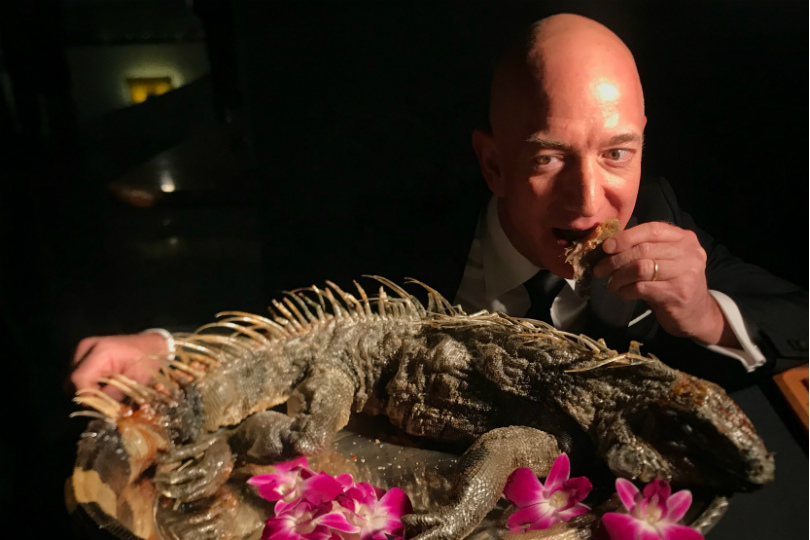
In any case, if this is a covert war it is working well as concerns making the rich richer, keeping us all looking the other way, and restructuring the world. But what about population reduction?
Whatever you think about CV-19 itself, you have to admit that no one is really dying from it at the moment. If you believe the official figures, which seem to include an awful lot of people who die having had a positive test result in the past at some point but not necessarily from CV-19, 4,000 people a day in a world of nearly 8 billion is not very many. As a practical consideration, were we all to live to a hundred, around 0.0027% of us would die every day. Currently 0.00007% are officially dying from coronavirus, so approximately 2% of deaths are due to this coronavirus, the rest are coronary artery disease, stroke, lower respiratory infections, chronic obstructive pulmonary disease (emphysema, bronchitis), lung disease and cancer, diabetes, Alzheimer's and dementia, diarrhoea, TB, road injury (in order)... In fact even this is not true: ALL the CV deaths had another underlying cause.
Note that road injury - a most preventable cause - kills twice as many per year as CV-19 has ever and, yet, no one is fretting about that. We stopped our economies for CV but never contemplated such a thing for road injury, which in 6 months kills as many as CV ever has.
Forget the asymptomatic CV-carriers. If they are carrying an illness which they can transmit and which is still not going to kill others, are they at all relevant? At its most virulent, CV has killed as many people as are murdered in a year in the world. Do we wish to lock up everyone because they may be a homicidal maniac?
You have to have a really blind faith in our deep state not to smell a rat of some sort, either grave conspiracy or plain old incompetence. Quickly forgotten are all the solemn speeches about China's lack of personal freedoms and democracy, as it becomes our model for how people should be ordered about.
China for 35 years, till 2015, had a 'one-child policy'. Those that were powerful or had money to bribe officials had more children, but those that depended on the state for welfare (as the unemployed, underemployed, furloughed, underpaid are) abandoned baby girls in huge numbers and bred pampered, lonely male children. Even in 2007 36% of the population was subjected to the policy, the rest having a series of exemptions. China now faces a serious demographic problems with the excess of lonely males who cannot marry, and old people facing a lonely old age.
It does seem that we are very shortly to be given the choice of never being able to go out, let alone travel, or accepting a vaccine that is largely untested, potentially lethal, probably useless against coronaviruses and unnecessary, as CV-19 is of late a non-story. Our collective immune system ALWAYS adapts to new viruses in time.
Is the vaccine, as many suspect, a Trojan horse to further reduce our fertility? Our elites almost certainly do not vaccinate themselves or their children: witness Tony Blair's refusal to answer this question in parliament, Bill Gates' doctor's comments, Zuckerberg's rather too public filming of his children at the clinic, Australia's NSW premier pretending to be vaccinated while the cap was on the syringe - there are too many instances to enumerate.
Hysteria was ramped up at the beginning with photos of coffins and the like. We never saw them in our own streets, although we did get to see nurses just about everywhere going through dance routines. Hysteria is now kept going - despite the dearth of even potential death suspects - with the contradictory narratives of asymptomatic illness (think about it); and - if you prefer - so few cases as to confer no herd immunity at the same time as hundreds of thousands of positive test results.
Will the new, largely untested vaccine get the second result of a WW done: population control? Vaccine trials are already being pushed in parts of Africa and Indian slums, although we are told that people there are NOT ill. After all, as The Guardian's headline shouts, "over half the people living in the slums of Mumbai have had the coronavirus", but way down we hear that "the survey results suggested asymptomatic infections were “likely to be a high proportion of all infections” and also indicated the virus death rate was likely to be “very low”." (One also wonders why The Guardian puts "very low" in inverted commas.) Will the vaccine sterilise us, as previous others have provably done? Will it make us weaker and iller, when this coronavirus - and no doubt future ones - weeds out the old and infirm?
Is this our new war, one we're sleepwalking into again? Are millions about to be willingly culled or sterilised, and will these same millions oblige the rest to be unwillingly culled or sterilised? Is the world order being intentionally reconfigured so that a handful of billionaires can get still richer while the obsolete masses are quarantined or exterminated?


